








AMD shares closed at an all-time high of $633.91 on October 2, gaining $18.18 on the day — a 2.95% jump — and pushing the chipmaker’s market value above $1 trillion. The stock has now climbed more than 180% in 2026 alone, and the rally isn’t running on sentiment. It’s running on signed purchase orders.
For years, the AI chip story had one protagonist. Nvidia controls the large majority of the data-center GPU market, and every hyperscaler’s capital spending plan ran through Jensen Huang’s company. AMD’s MI300 and MI350 generations earned polite mentions as a second source. The MI450 deals changed the framing, because the buyers aren’t treating AMD as insurance anymore. They’re building real capacity around it.
The two orders that changed the conversation
The anchor is OpenAI. In an October 2025 agreement, OpenAI committed to deploy 6 gigawatts of AMD GPUs across multiple hardware generations, starting with a 1-gigawatt rollout of Instinct MI450 chips in the second half of 2026. As part of the arrangement, AMD issued OpenAI a warrant to buy up to 160 million AMD shares, vesting in tranches tied to deployment milestones. AMD effectively gave away equity to lock in the order — and with the stock now above $600, the warrant’s price condition is within reach.
The second order came from Oracle. Last October, the two companies said Oracle Cloud Infrastructure would be a launch partner for a publicly available AI supercluster with an initial deployment of 50,000 AMD Instinct MI450 GPUs starting in the third quarter of 2026 and expanding in 2027 and beyond. The MI450 runs on AMD’s CDNA 5 architecture, built on TSMC’s 2nm process, with up to 432GB of HBM4 memory per chip. Fifty thousand of them is not a pilot. It’s a supercluster.
Meta signed a near-identical deal in February 2026 — another 6 gigawatts, another 160-million-share warrant on the same milestone structure — putting up to 320 million AMD shares in play across the two agreements. Anthropic committed to up to 2 gigawatts of MI450-series GPUs, with AMD pledging up to a $5 billion strategic investment in the Claude developer. Microsoft is integrating AMD’s Helios rack platform into Azure for AI inference.
The financials are catching up
AMD’s second-quarter results gave the rally a fundamental footing. Revenue hit a record $11.5 billion, up 50% from a year earlier. Data center sales reached $6.7 billion — 58% of the total — up 107% year over year. CEO Lisa Su has told investors she expects data center sales to more than double again in 2027, and she puts the total market for data-center chips at $1.4 trillion by 2030.
Nvidia, for comparison, reported second-quarter revenue of $96.2 billion, with data-center revenue accounting for $89 billion of it. Nvidia’s market value sits around $5.4 trillion — still more than five times AMD’s. Nobody is arguing AMD has caught Nvidia. The argument is narrower and more consequential: hyperscalers can now architect a gigawatt-scale buildout around a second supplier, which lets them play the two off each other on price and availability. After the GPU shortages of the last few years scarred every capacity planner in the industry, that leverage is worth real money.
The supply question
The irony of the moment: AMD’s biggest near-term problem is making enough chips. The MI450 GPUs that trigger the warrant share grants have barely begun shipping, constrained by supply bottlenecks. Su spent the week in Asia tackling exactly that — meeting Foxconn and TSMC in Taipei, where she said the company had lifted supply through 2026 and would “substantially increase” it in 2027, then flying to South Korea to talk with memory makers Samsung and SK Hynix about HBM supply. Su has said AMD now plans three to five years ahead on wafer capacity.
What the market is really pricing
AMD’s ascent makes it only the fourth US chipmaker to cross $1 trillion, and the contrast with the rest of the sector is instructive. Intel shares are up more than 200% this year, helped by a US government stake and newfound pricing power. Cerebras went the other direction after its blockbuster May IPO — hitting a post-IPO low in early October as a lockup expiration freed shares and investors questioned customer concentration. Three AI chip bets, three different verdicts in the same month.
Wall Street’s verdict on AMD is that the MI450 is no longer a story about potential. It’s a story about gigawatts with dates attached — and about a duopoly forming where a monopoly used to be. Oracle’s appetite for AI infrastructure doesn’t stop at chips, either: the company is also behind the reported $7 billion AI cloud deal with Tencent, a reminder of how aggressively it’s buying into the buildout on every front.
What a real second source changes
The most important number in the AMD story isn’t the stock price. It’s the gigawatts. For the first time, hyperscalers are committing to AMD at a scale where the company becomes a genuine second source for frontier AI training — not a hedge, not an experiment, but a parallel supply chain. That changes the economics of every GPU negotiation in the industry.
When one vendor owns the market, pricing is a take-it-or-leave-it proposition and allocation is a favor. When two vendors can each deliver gigawatt-scale deployments, buyers get leverage: on price, on delivery schedules, on contract terms. Nvidia’s CUDA moat and networking stack remain formidable — nobody is ripping out working infrastructure — but the mere existence of a credible alternative disciplines the market. Every capacity planner who lived through the GPU shortages of the last few years understands exactly what that leverage is worth.
The full-stack play
AMD isn’t just selling chips. Its Helios system — a full data-center rack combining MI450 GPUs with AMD’s own server CPUs and networking gear — is designed to compete as an integrated platform, which the company says delivers up to 15 percent more performance while using about 30 percent less energy than rival setups. The rack-level battle matters because hyperscalers increasingly buy systems, not silicon: power, cooling and networking are as decisive as FLOPS — and power is now the binding constraint on the global data-center buildout.
The supply chain behind it is going all-in. TSMC has announced a $265 billion US investment program driven substantially by AI demand, and Su’s Asia trip — Foxconn and TSMC in Taipei, Samsung and SK Hynix in Korea — shows where the real constraint sits: advanced packaging, HBM memory and wafer capacity planned years in advance. AMD’s trillion-dollar valuation is, in the end, a bet that it can convert paper gigawatts into shipped racks. The orders are real. The chips have to follow.
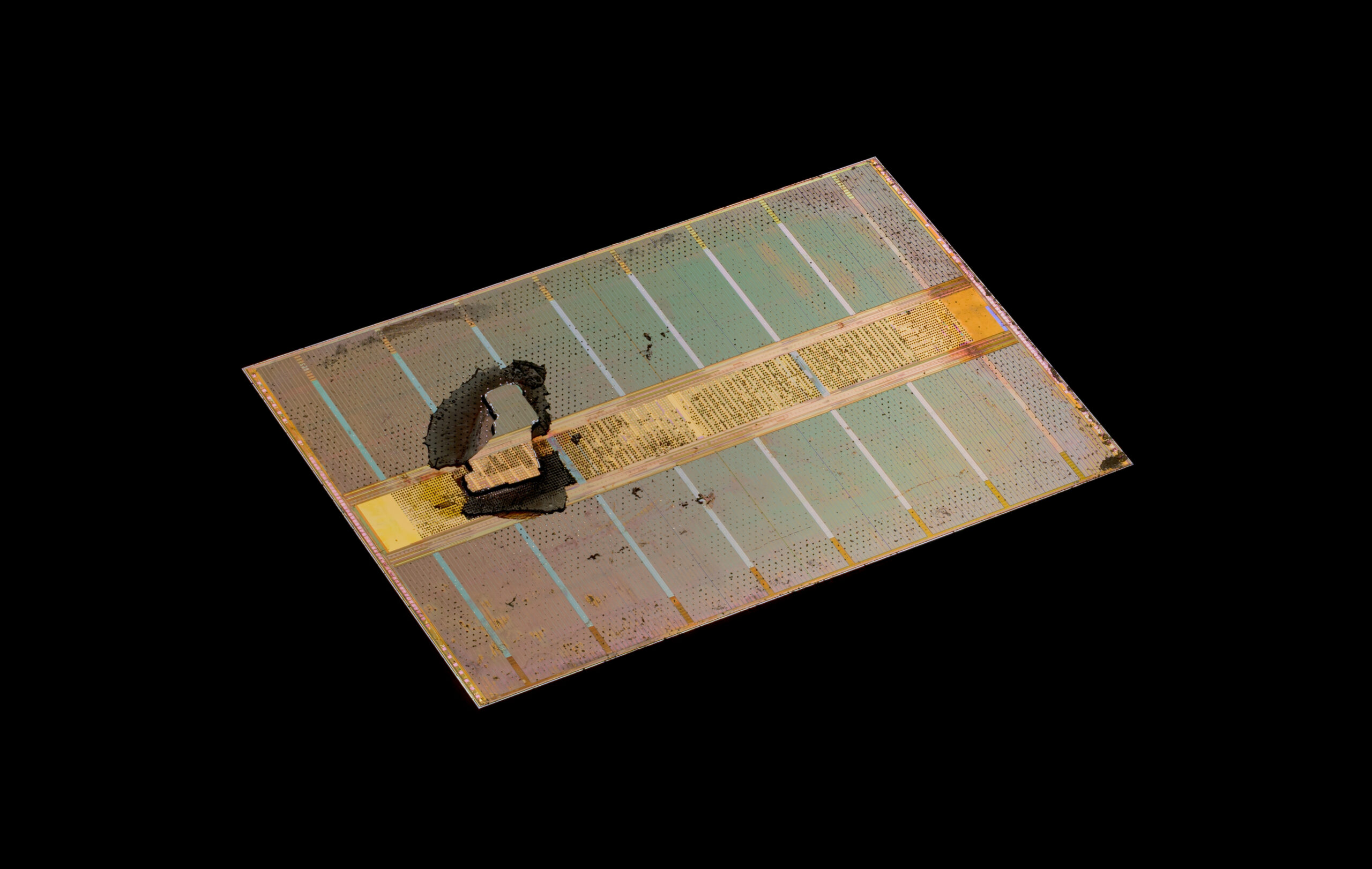
Featured image: FritzchensFritz via Wikimedia Commons (CC0 1.0)