Microsoft quietly introduced a new model this week, and it is not the kind of release that usually makes headlines. There is no chatbot, no image generator, no demo of a robot pouring coffee. Instead, Microsoft-Decision-1 is a compact, specialized model built for one narrow job: making structured decisions fast and cheaply. According to Microsoft, it handles routine judgments around 35 times faster than GPT-6 Sol — and the company says it can beat larger models on the decision-heavy tasks that AI agents chew through all day.
If the claims hold up, Decision-1 points at a shift in how AI infrastructure gets built: fewer giant models doing everything, more small specialists handling the boring work.
What Decision-1 actually does
Decision-1 is not a general-purpose language model. It does not write essays or answer trivia. Its job is to pick between predefined options and attach probability scores to possible outcomes — the kind of work that shows up constantly inside software: Is this comment spam or not? Which support queue should this ticket go to? Does this piece of content pass quality checks? Should a task be retried, escalated, or sent to a human for review?
That sounds mundane, but it is the operating cost of every AI agent workflow. When an agent runs, it makes dozens or hundreds of these micro-decisions: whether a step succeeded, whether to try again, whether the result is safe to act on. Each one currently goes through a full-size language model, which is like calling a senior consultant to approve a parking validation. Microsoft’s argument is that this is wasteful, and that a purpose-built model can handle the routine calls while the big models stay reserved for reasoning and text generation.
The model is built on top of Qwen3.5-9B, Alibaba’s open-weights model family, and has been through specialized post-training aimed at decision scoring. That lineage matters: it suggests Decision-1 inherits a strong base understanding of language, then gets tuned for classification-style judgments rather than open-ended generation. It also fits a pattern we have seen all year — companies taking open-weight foundations and carving them into cheap, task-specific specialists. Our recent guide to running open-weight models locally with Ollama shows how this same class of compact model is finding a home on developer machines, not just in data centers.
The numbers Microsoft is putting up
The headline figure is speed. Microsoft says Decision-1’s median latency is approximately 35 times faster than GPT-6 Sol and 4.5 times faster than Quyet-1.0-Large, a smaller model from another developer. On accuracy, the company reports that Decision-1 ranked first across 36 benchmark tests covering nearly 150,000 questions — a result that, if true, would be genuinely unusual: faster and more accurate on the specific tasks it was built for.
Then there is the Xbox test, which is the most concrete real-world data point Microsoft has shared. The company’s Xbox Research team ran Decision-1 over more than 10,000 pieces of game feedback and reviews — a classic messy, high-volume classification job. According to Microsoft, the model produced quality comparable to GPT-6 Sol while running more than 14 times faster and costing roughly one-two-hundredth as much. Those are Microsoft’s numbers, not an independent audit, and the company itself has not published a public methodology that outsiders can reproduce. Treat them as a marketing-grade upper bound until third parties run their own tests.
Still, the shape of the claim is plausible. Narrow models beating big ones on narrow tasks is one of the oldest findings in machine learning — it is the same reason your phone can recognize your voice without calling a data center. The interesting question is not whether a 9B decision specialist can beat a giant generalist at classification. It is how often, in production, the decisions stay as tidy as the benchmarks assume.
Why AI agents are the real target
Read the feature list and the use case is obvious. Decision-1 supports yes-or-no decisions, multiple-choice selection, ratings, and rubric-based evaluations. Microsoft lists applications including content classification, application routing, task prioritization, quality control, result verification, and safety screening. In agent workflows, it is meant to answer the routing questions: should this task continue, should this operation be retried, should this issue be escalated, does a human need to look at this?
This matters because agent economics are breaking. Teams building agents on top of frontier models have discovered that the model bill is not driven by the hard reasoning steps — it is driven by the thousands of small judgments around them. Every guardrail check, every routing decision, every verification pass costs tokens. A model priced for that work could change what gets built. We covered the developer tooling side of this wave in our piece on LangChain’s Deep Agents update, and the broader shift toward simple, composable agents with smolagents — Decision-1 is the infrastructure that would sit underneath all of that, doing the unglamorous scoring work for pennies.
The pricing is the point
Microsoft has priced Decision-1 at $0.042 per million input tokens, with output tokens free. To put that in perspective: scoring one million short decisions would cost less than a nickel. That pricing structure only makes sense for one business model — high-volume, repetitive decision work where the margin lives in scale, not in each call.
Free output tokens is a telling detail. Since the model’s outputs are short — a label, a score, a probability — Microsoft is effectively saying: pay for what you send in, the judgment itself is cheap. Compare that to general-purpose models, where long reasoning traces and verbose outputs inflate every call. For content moderation pipelines, support ticket routing, or continuous quality-control loops, the difference between a few cents and a few dollars per million decisions is the difference between a pilot project and a production deployment.
Microsoft’s safety homework
Microsoft says it tested Decision-1 for harmful-content identification, jailbreak attempts, and prompt injection — the standard battery for any model that will sit inside automated pipelines. One number stood out: across eight different input perturbation methods, the model’s average decision-change probability was 1.3%, meaning small variations in phrasing rarely flipped its verdicts. Consistency under rewording is a useful property for a model whose entire job is judgment, and it is also one of the easier metrics to measure honestly.
Even so, a decision model carries a specific risk profile. When a chatbot is wrong, someone reads the wrong answer. When a decision model is wrong at scale — misrouting medical triage tickets, misclassifying safety violations — the damage compounds silently across millions of calls. Microsoft’s testing covers the model’s own robustness, but the harder problem is always the pipeline around it: who audits the scorer, and what happens when it drifts. That governance question applies to every automated decision system, and it is worth asking before the 35x-speedup math makes human review look like an extravagance.
Where to get it, and what to watch for
Decision-1 is available to developers through Microsoft Foundry, Microsoft’s AI development platform, with access on OpenRouter reportedly planned. OpenRouter availability would matter: it is the easiest path for independent developers to try the model without committing to Microsoft’s platform, and independent benchmarks are the missing piece of this story. For teams chasing inference speed, our coverage of TensorFold’s inference engine is a useful companion read on how much the serving layer itself can change the economics.
The launch is part of a broader strategy Microsoft has been telegraphing for a year: separate routine decision-making from heavyweight reasoning and generation, and sell the market on both. It is the same logic behind the industry’s obsession with inference efficiency — smaller models, faster serving, lower cost per decision.
The honest version of this story is a bet. If independent testing confirms even half of Microsoft’s speed and accuracy claims, Decision-1 could become the default scoring layer inside agent frameworks within months. If the numbers prove to be benchmark-tailored, it joins a long line of “small model beats big model” announcements that looked better in a slide deck than in production. Either way, the direction is set: the future of AI agents is not just smarter models, it is cheaper decisions. Microsoft just fired the starting gun.
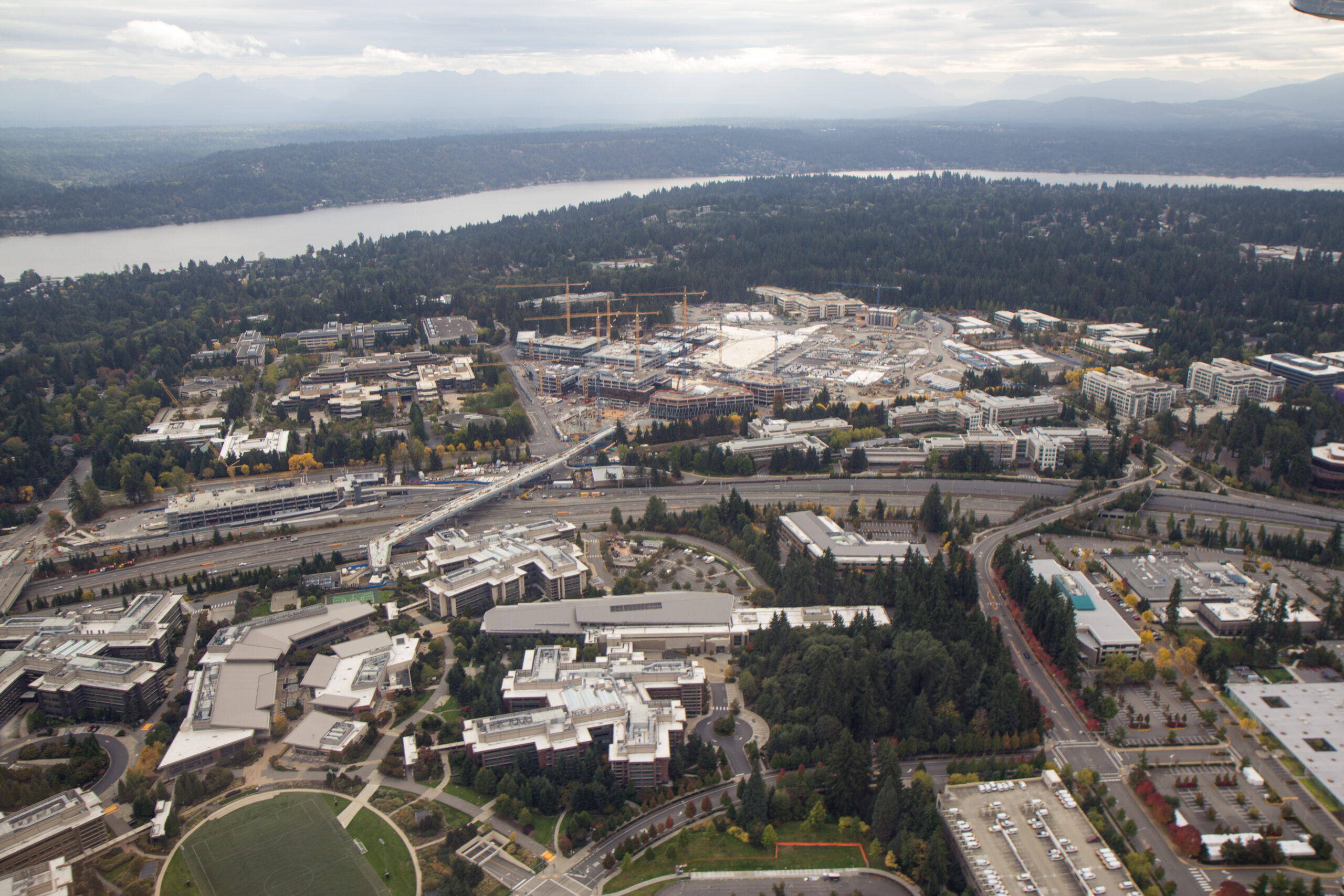
Photo: Aerial view of the Microsoft campus redevelopment in Redmond, Washington. Image by Atomic Taco via Wikimedia Commons, licensed under CC BY-SA 2.0.