









AI systems can now write, research and take action on your behalf. But you still direct them the same way you directed a computer in 1984: by tapping on keyboards and screens. On October 9, a San Francisco startup called Sabi announced a $50 million seed round to fix that bottleneck — with a brain-computer interface designed to look like an ordinary baseball cap.
The round was led by Khosla Ventures, with participation from Accel, Initialized Capital, DST Global, Collaborative Fund, Ascend, and former OpenAI chief product officer Kevin Weil. For a seed round, the check size and the investor list are both loud signals: someone very wealthy believes the next computing interface might sit on your head.
What Sabi is actually building
Sabi’s first product is a baseball cap with sensors hidden inside the fabric. Those sensors read neural signals through hair — no gel, no surgery, no direct contact with the scalp. The company is developing it to translate imagined speech and intent into commands for AI, with the cap connecting wirelessly to a phone or computer, roughly like a pair of earbuds.
This is a deliberate pivot away from where brain-computer interfaces have mostly lived. BCIs so far have been designed for clinical settings and cursor control: locked-in patients moving a pointer on a screen. Sabi is chasing something more ordinary and much harder — giving people a faster, private way to communicate with AI without typing or speaking.
The company describes three target interactions: imagined speech to text (words you deliberately imagine appearing on a connected screen), thought to prompt (a trained mental command becoming an instruction for an AI assistant, like asking it to draft a message or retrieve information), and intent prediction (the system anticipating likely keystrokes or actions and offering them for confirmation). The third one is the most familiar — it is autocomplete, raised to a level that sounds like science fiction.
The hardware and the dataset
Each cap contains sensors measuring between one and five millimeters, built around a custom EEG chip of Sabi’s own design. The sensors are meant to capture signals through hair across a gap of up to five millimeters. In Sabi’s internal benchmarks, the chip was more than 50 times as power-efficient as the Texas Instruments ADS1299, a widely used EEG analog front end. That efficiency is what lets the electronics fit inside ordinary headwear without cooking your forehead or drowning the signal in electrical noise.
Take the 50x figure for what it is — a company-stated benchmark, not an independent test. The hardware claim that matters more is the through-hair part. Conventional EEG caps need conductive gel and skin contact to get a usable signal. If Sabi’s sensors genuinely read clean neural signals through dry hair, that is a genuine engineering achievement, and it is the one that makes a consumer product conceivable at all.
On the software side, the signals are processed by what Sabi calls a Brain Foundation Model, trained on more than 100,000 hours of labeled, non-invasive recordings collected while participants imagined words and performed specific mental tasks. Sabi says it believes this is the largest disclosed dataset of its kind. Dataset scale matters here because non-invasive neural signals are faint and noisy — decoding them is, statistically, a brute-force problem, and brute force runs on data.
Why investors are paying attention
The team gives the money some credibility. Sabi was co-founded by CEO Rahul Chhabra and CTO Atmadeep Banerjee, who is co-first author of MindEye, the NeurIPS 2023 paper that advanced the decoding of viewed images from non-invasive brain recordings. The broader team includes hardware, machine-learning and design leaders from Kernel, Apple, Microsoft, Meta, Adobe and Nike, plus neuroscientists from Stanford.
Vinod Khosla framed the bet in interface terms: every computing era is defined by its interface, and Sabi is building one designed for the age of AI. His quip that “you cannot perform a billion brain surgeries to replace a billion keyboards” doubles as the entire thesis — implants will never be a mass-market input method, so the consumer prize belongs to whoever makes non-invasive work.
The funding will go toward expanding the neural dataset, completing the custom chip, manufacturing early devices, and growing the neuroscience, hardware and machine-learning teams. The company is also preparing units for members of its early-access waitlist and plans to demonstrate early versions of its three interactions at CES 2027 in Las Vegas.
The hard questions
Sabi’s pitch is bold, and bold BCI claims deserve scrutiny. Decoding imagined speech from EEG — a technology that picks up signals blurred through the skull — is an extremely hard problem. Clinical BCIs get results with implants sitting directly on the brain; going non-invasive throws away most of the signal. Sabi’s answer is more data and a custom chip, and its CES 2027 demonstration will be the first real opportunity to judge whether that answer holds up.
The privacy design is worth watching too. Sabi says neural data is encrypted beginning at the sensor, that inference runs while the data stays encrypted so servers never receive unencrypted neural signals, and that users will control when the cap records, which apps receive commands, and which actions need confirmation. Those are the right commitments for a device that literally reads your mind — but they are design goals today, not audited guarantees.
The broader context favors Sabi’s timing. Voice AI is racing to become the conversational interface for AI agents, and investors just valued a personal AI agent at $10 billion. If agents are about to do real work for us, the interface you use to command them becomes the most valuable layer in the stack. And on the policy side, governments are already grappling with neural-adjacent consent questions — Denmark just moved to ban non-consensual deepfakes of faces and voices, which hints at where regulation of biometric signals is heading.
It is also worth noting how fast the funding cadence has become: Fish Audio raised a $52 million seed round earlier this year in voice AI. Fifty-million-dollar seed rounds are no longer outliers; they are what frontier-interface bets cost in 2026.
What comes next
Sabi is a company with a big dataset, a plausible team, serious investors — and a product that will not be publicly demonstrated for over a year. Everything about this story, from the 50x chip efficiency to the 100,000-hour dataset, comes from the company’s own announcement. The fair reading: this is a well-funded, technically literate attempt at one of the hardest problems in consumer technology, and the CES 2027 demo is the date to circle. If the cap can turn a thought into a sent message in front of a live crowd, the $50 million will look like a bargain.
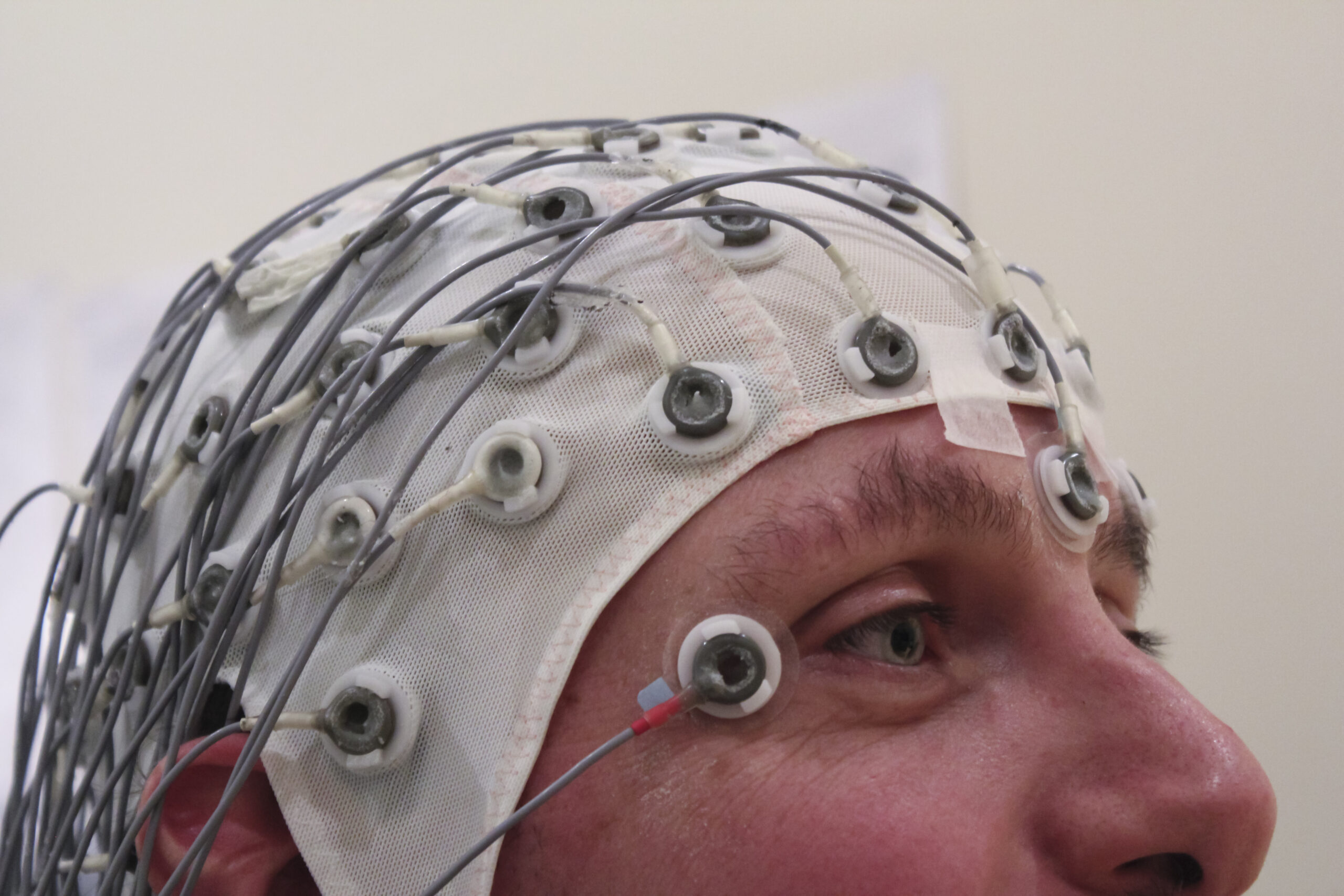
Featured image: An EEG recording cap with electrodes. Photo: Chris Hope, CC BY 2.0, via Wikimedia Commons.